


- Home
- Other Projects
- Vanaspati Plants
Projects we offer
Vanaspati Ghee Plant Manufacturer Process
Vanspati is a consistent blend of edible vegetable oils that are refined & and hydrogenated to produce pure cooking fat. It is produced through controlled hydrogenation of edible oil. The colour, texture, and hardness resemble natural ghee. It acts as an alternative to the traditional butterfat ghee. Vanaspati is semisolid in nature with a coarse granular structure, and it usually requires a melting point of 37°C-39°C. The desired granular texture can be improved by interesterification.

Process Steps:
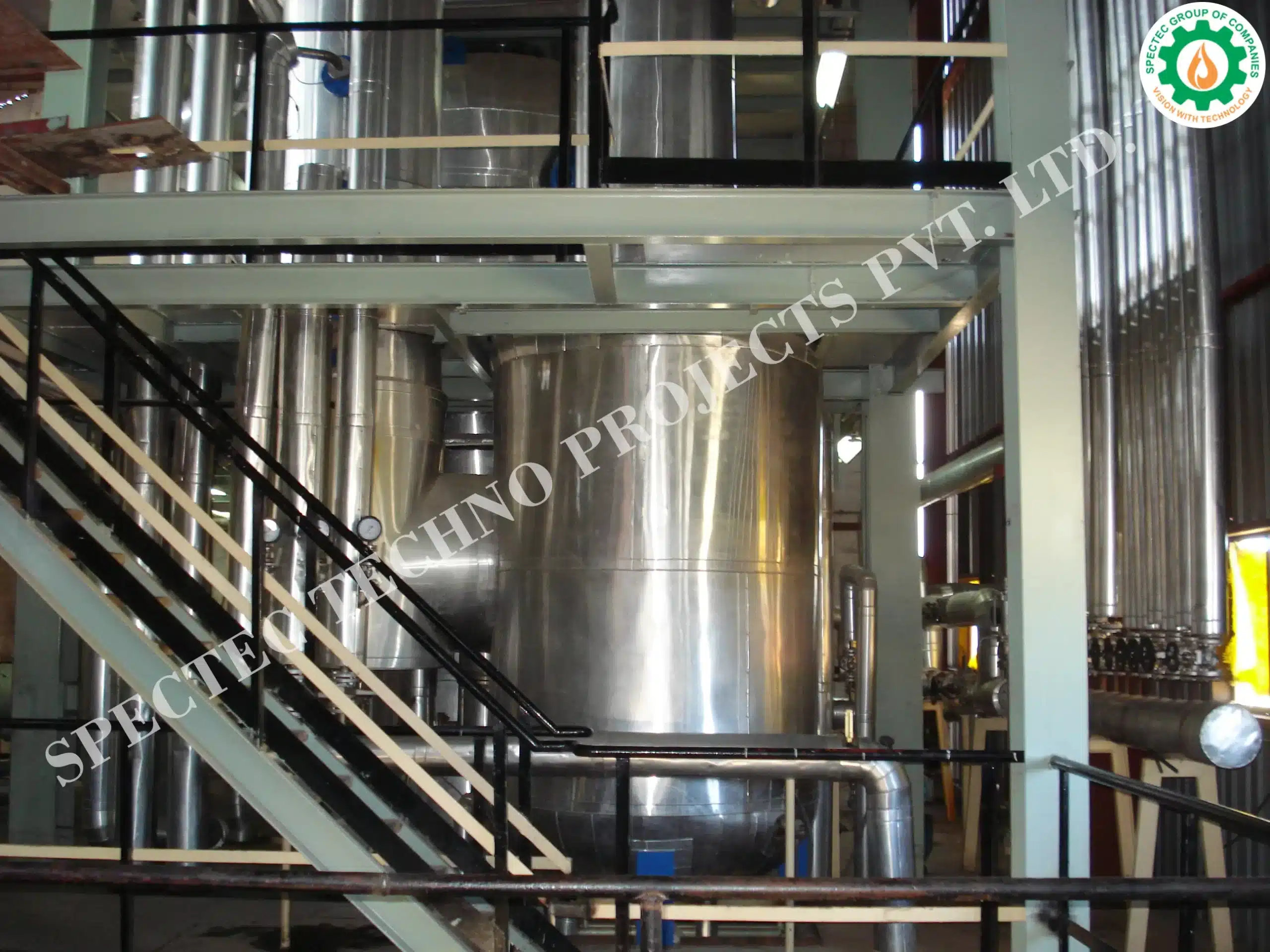
Hydrogenation
CPO/palm stearin/other soft oil from storage tanks is directly pumped to the autoclave through the hydrogenated fat cooler, where the heat is exchanged. The autoclave is specially designed to heat and cool the oil during the reaction and is provided with a catalyst dosing and sampling system.
The oil is fed to the autoclave, and the oil is heated to the reaction temperature in the presence of a spent catalyst with vigorous mixing through the specially designed combination agitation system. After attaining the required temperature, the compressed hydrogen is passed at very low pressure, and the required quantity of catalyst is dosed when the consumption of gas slows down.
The samples were drawn to check the progress of the reaction.
The hydrogenated oil, after completing the reaction, is dropped into the cooler for further heat exchange and finally cooled with cold water.
The material is filtered in leaf filters or C-plate and frame traditional filters with cotton filter cloth to remove the catalyst.
The filtered oil is then passed through the Polish filters to remove the traces of catalyst.
Interesterification
Interesterification consists in modifying the physical properties of the oil by an interchange of fatty acids between and inside the different triglycerides by means of a catalyst. This is done by a catalyst operating at about 100 °C and under vacuum. The blending of oils at elevated temperature to
interchange the fatty acid group.
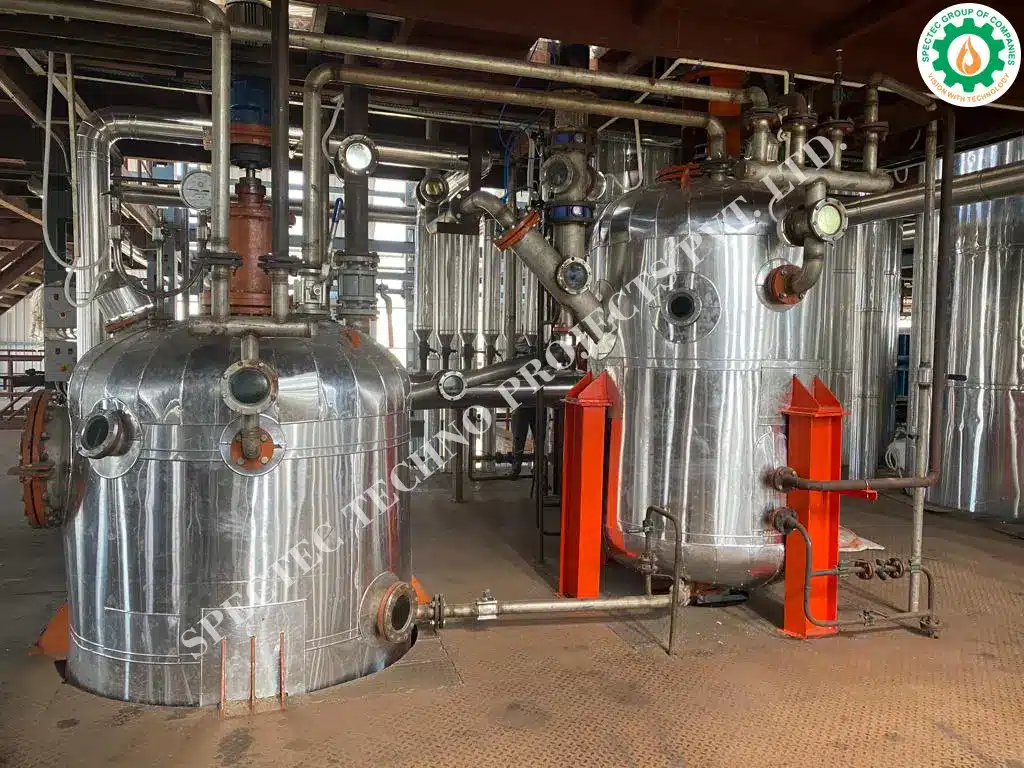
Palm Stearin and soft oil from storage tanks are directly pumped to the homogeniser, where both the oils are heated and mixed properly. The homogenised oil is pumped to the reactors for further processing. The oil is heated to the reaction temperature with vigorous stirring; the catalyst is dosed in the required quantity; this is stirred continuously to propagate the reaction. The reaction takes approximately one to one and a half hours, and the total cycle time is approximately 4 to 5 hours. The esterified oil is then transferred to the cooler for cooling and to the intermediate storage tanks.
Neutralization
The hydrogenated oils are pumped to the neutralisers from the intermediate tank. The oil is heated up to 60-70’C by means of the live steam provided in to the neutraliser and the required amount of hot water wash to allow the nickel particles to settle. After 2-3 hours, wash water is drained off in the slope oil tank.
Post Bleaching
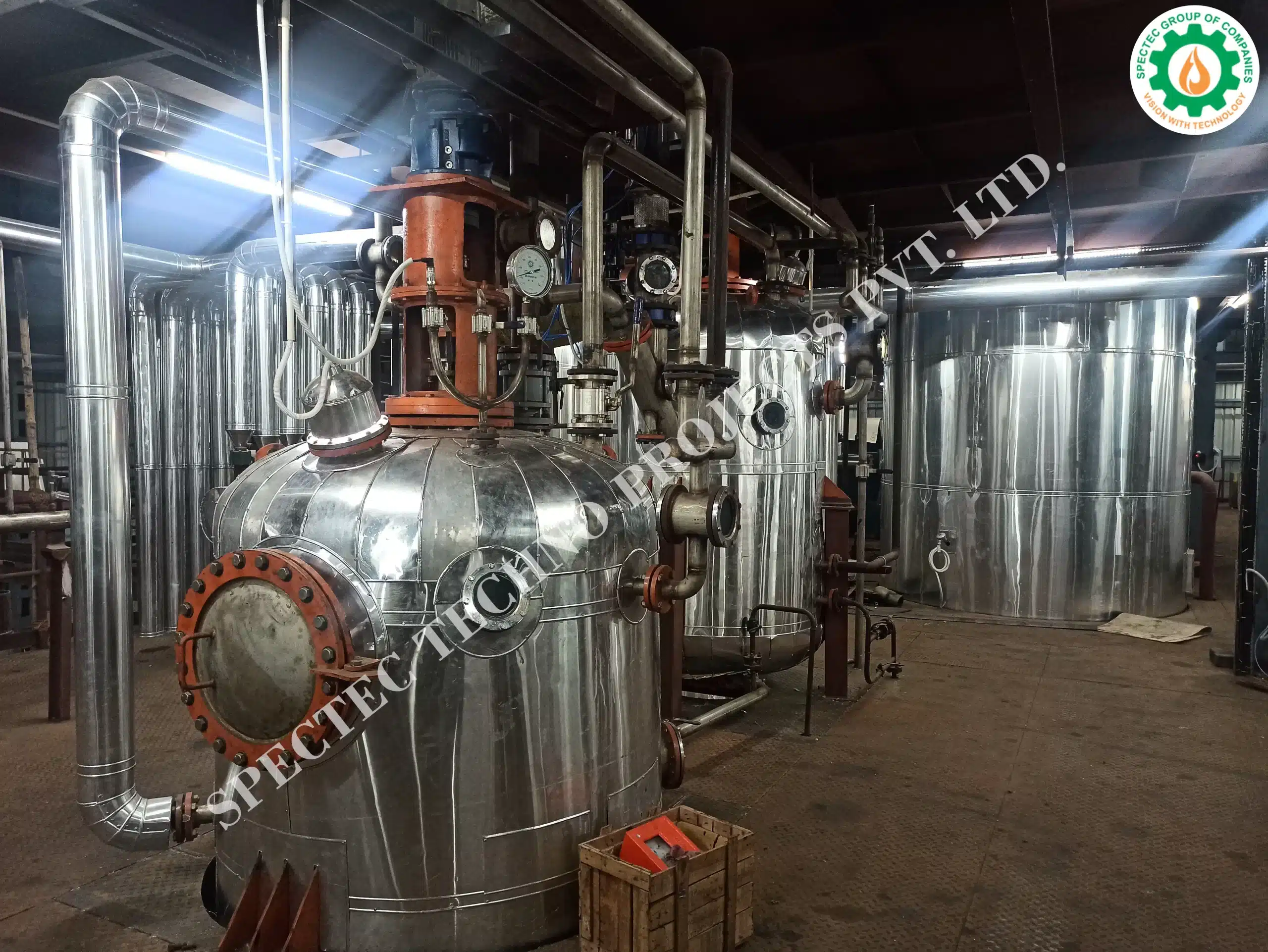
After neutralisation, the hydrogenated oil is pumped to the post blender, and at the same time, part of the oil is carried to the slurry tank. The oil is cooled before passing to the slurry mixer. A precalculated amount of bleaching earth is added in the slurry mixer; this slurry is sucked by means of vacuum to the bleacher.
After proper holding and mixing, this oil is sent to the alternative operating set of the pressure leaf filter. after this filtration, the oil is again filtered by the alternative operating set of polishing filters. Then it is cooled by a shell and tube cooler.
Deodorization
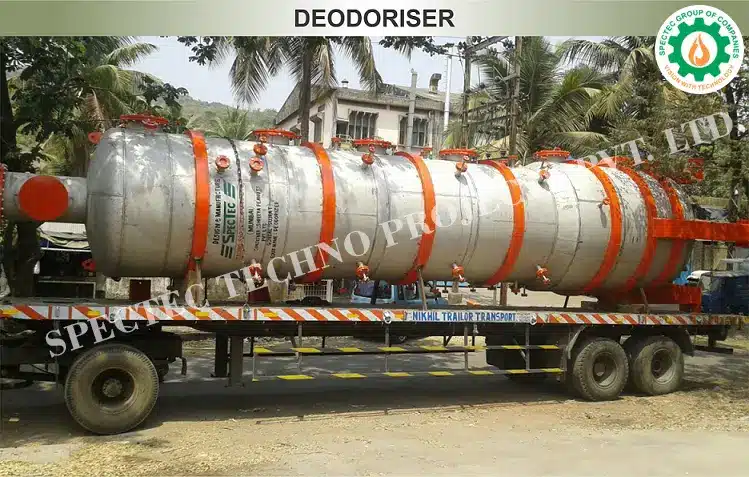
Deodorising is nothing but the distillation process. In which fatty acid is distilled from oil. Under high temperature conditions and in the presence of a high vacuum, with the help of sparging and agitation steam. Further, this fatty acid in vapour form is condensed and recovered in liquid form by the vapour crubbing system. Bleached oil from the intermediate storage tank is pumped by the oil-to-oil heat exchanger. Where bleached oil is heated by the outgoing hot refined oil. Then this oil is going to the pre-heator via. Peripheral coils of the regenerative heat exchanger, which is the bottom compartment of the multipurpose deodoriser. In a regenerative heat exchanger, de-waxed oil flows through the coils and refined oil flows through the open space of the exchanger. In the current manner, continuous steam agitation at the open steam side assures continuous and maximum heat exchange.
After recovering maximum heat from the refined oil,. Oil is further heated up to the required temperature, suitable for the deodorising in the final heater. This heater is equipped with agitation and sparging steam; the continuous flow of superheated steam through it assures effective primary vaporisation of fatty acids.
Further, this overflows to the multi-compartment deodoriser. Deodoriser is a multi-compartment vertical vessel where each tray is specially designed, which ensures uniform distillation of odoriferous substances. Oil overflows from tray to tray. Specially designed trays provide sufficient mass transfer surface for effective removal of volatile matters. The flow control system at the outlet of the deodoriser ensures the maintenance of the required level at the bottom tray. The steam used for stripping off volatile matters in the oil is distributed evenly and intensively. The steam meets the deodorised oil and strips off the volatile matter and rises through the vacuum, stripping the volatile matter from the oil. The counter-current flow of steam and oil like this in specially designed trays lowers steam consumption than the conventional deodorisers. The deodorised oil leaves the regenerative heat exchanger and is finally cooled by water in the heat exchanger. Finally, this oil is passed through the alternatively operating set of polishing filters.
Vapors Scrubbing
The volatile matters consisting of free fatty acids and other odoriferous substances stripped from the deodoriser are led to the vapour scrubber located at the outside of the deodorising column. In the scrubber, volatile material rises through the bed of pall rings and meets liquid fatty acid sprayed from the top. Vapours are condensed, cooled, and then recalculated to condensed fresh vapours. Excess distillate collected is led to the storage tank whenever a high level is reached in the storage space below the scrubber.
Fatty acid scrubber is specially designed for minimum carryover of fatty materials to the vacuum system.
- What is Vanaspati and how is it used in food products?
Vanaspati is a hydrogenated vegetable oil used as a cooking fat and a cheaper substitute for ghee (clarified butter), made by converting liquid vegetable oils into solid or semi-solid fats through a hydrogenation process, often using palm oil
- What is Vanaspati and how is it used in food products?
- What is Vanaspati ghee and how is it different from natural ghee?
Vanaspati is made from liquid vegetable oils through a hydrogenation process that creates unhealthy trans fats, while natural ghee is a dairy product with healthy fats and nutrients
- What is Vanaspati oil made from?
Vanaspati oil is made from hydrogenated vegetable oils, primarily palm oil, but also soybean, sunflower, and groundnut oils
- How is Vanaspati ghee made in a Vanaspati plant?
Vanaspati ghee is made in a plant through the process of hydrogenation, where hydrogen gas is added to liquid vegetable oils (like soybean, sunflower, or palm oil) under high pressure and in the presence of a nickel catalyst
- What is vegetable ghee and how does it relate to Vanaspati?
Vegetable ghee is a term for hydrogenated vegetable oil, which is a hardened fat made to resemble traditional ghee but is a cheaper substitute. Vanaspati is another name for this hydrogenated vegetable oil and is often used interchangeably with “vegetable ghee” in modern Indian markets
- What is the Vanaspati ghee manufacturing process?
Vanaspati ghee is manufactured through the controlled hydrogenation of permitted vegetable oils, primarily palm oil, in the presence of a nickel catalyst
- What raw materials is Vanaspati made from?
Vanaspati is made from various liquid vegetable oils, such as palm oil, palm olein, soybean oil, cottonseed oil, and sunflower oil
Read More for Related Refinery Projects
Vanaspati Ghee Plant - FAQ